Toward AI-based Classification of Ground-based Auroral Emission Spectra

Aug 24, 2026·
Gaël Cessateur
Matthieu Le Lain
Matthieu Le Lain
,
Hervé Lamy
,
Sébastien Lefèvre
,
M. G. Johnsen
,
M. Barthelemy
,
G. Bertrand
· 1 min read
Abstract
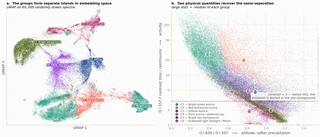
The ASIS spectrograph in Skibotn has recorded auroral spectra every 30 s since October 2023, an archive far too large for systematic manual inspection. The poster combines two complementary approaches. First, a supervised proof of concept on 719 expert-annotated spectra, where an MLP baseline and a 1D Vision Transformer reach comparable performance (macro AP 81.1% and 77.8%) and the ViT-1D attention maps localise physically meaningful emission regions. Second, an unsupervised exploration of the full archive: 328,281 spectra acquired over 220 nights between October 2023 and January 2026 organise, without labels or a predefined number of classes, into six recurrent spectral states. Four correspond predominantly to auroral observations and order themselves along the O I 630.0/557.7 nm ratio and the 557.7 nm line contrast, two established auroral diagnostics that were never used as targets. The remaining two identify non-auroral sky conditions and account for about 26% of the archive.
Date
Aug 24, 2026 — Aug 28, 2026
Location

Kiruna, Sweden

events

Co-authored poster presented by Gaël Cessateur (Royal Belgian Institute for Space Aeronomy) at the 22nd International EISCAT Symposium, held jointly with the 49th Annual European Meeting on Atmospheric Studies by Optical Methods in Kiruna, Sweden, August 24-28, 2026. I am second author and contributed the machine learning side of the work.

The poster brings together two halves of our collaboration on the ASIS spectrograph in Skibotn. The first is the supervised proof of concept published at RFIAP 2026, where a 1D Vision Transformer recovers known emission lines through its attention maps. The second extends the analysis to the entire archive: 328,281 spectra recorded over 220 nights, clustered without any expert label, separate into six recurrent spectral states. The four auroral states line up along the O I 630.0/557.7 nm ratio and the 557.7 nm line contrast even though neither quantity was used as a target, which suggests the grouping tracks a real physical continuum rather than an artefact of the representation. The two remaining states capture twilight, Moon and scattered light, and double as a first-pass archive-cleaning filter.

This motivates the next step of the project: learning directly from complete spectra with self-supervision, instead of from a predefined set of emission-line descriptors.

Matthieu Le Lain
Authors
AI for astronomy & astrophysics
PhD student at IRISA, Université Bretagne Sud (expected 2026), and lecturer in computer science, working on foundation models for astronomy and astrophysics, with a broader interest in deep learning applied to scientific data. Also contributing to the UniverseTBD collaboration on vision-language models for astronomy.