NORVIS
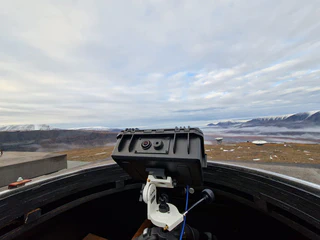
NORVIS (NORdlys Versatile Imaging Spectrograph) is a portable broadband imaging spectrograph for coordinated auroral observations across a network of high-latitude observatories.
NORVIS is led by the Royal Belgian Institute for Space Aeronomy (BIRA-IASB) and developed by the STAROS team, together with IPAG (Grenoble), the Tromsø Geophysical Observatory (UiT), the Swedish Institute of Space Physics (IRF Kiruna), the University Centre in Svalbard (UNIS) and the Finnish Meteorological Institute. “Nordlys” means aurora in Norwegian.
The instrument
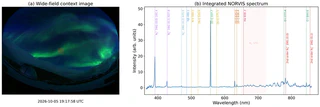
A slit spectrograph covering 380 to 860 nm in a single acquisition at about 1.2 nm resolution, housed in a lightweight 3D-printed enclosure. Three cameras work together: a cooled science camera records the spectrum, a slit-context camera locates the slit on the sky, and a wide-field camera captures the surrounding auroral morphology. All units share the same optical and acquisition design, so that spectra from different sites can be compared directly.
A network of identical units
First light took place during a campaign at Skibotn Observatory, Norway, in February 2026, with about 1200 spectra reduced over three nights. A permanent unit at the Kjell Henriksen Observatory in Svalbard recorded its first auroral spectra on October 5, 2026. Further deployments are planned at Kiruna, Skibotn and Nyrölä, forming a distributed network operated within a researcher-citizen science framework. The instrument is described in a paper under open review for Geoscientific Instrumentation, Methods and Data Systems.
My involvement
Within the STAROS development team, I am in charge of the software development of the NORVIS Suite (acquisition, reduction and visualisation applications) together with Guillaume Bertrand, and I am a co-author of the instrument paper. The project is the natural continuation of my work on the automated analysis of auroral spectra, from the supervised classification of ASIS spectra to self-supervised pretraining on the full archive: a network of identical spectrographs producing spectra every 30 seconds is exactly the setting where such methods become necessary.
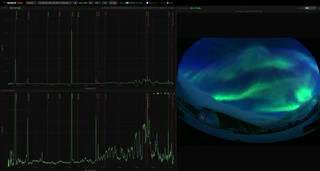
Images: NORVIS project, BIRA-IASB (norvis.aeronomie.be).
