The Great Chat in the Sky: Aligning Exotic Astronomical Data to Language with AstroBridge
Oct 26, 2026·,,,,, ,,,,,,,·
1 min read
Ibrahim Habib
Kevin Li
Trung Nguyen
Gabriel A. Patron
Gaurav Sekar
Nolan Koblischke
Matthieu Le Lain
Shashwat Sourav
Aman Kumar
Kartheik G. Iyer
Joshua S. Speagle
Itai Sfaradi
Michael J. Smith
Ioana Ciucă
Abstract
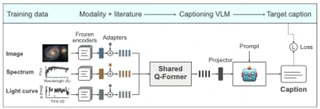
Astronomical observations include images, spectra, and light curves, while the scientific literature describes these objects in natural language. We present AstroBridge, a framework that connects these observations to an LLM through a literature-assisted caption generation pipeline. We used catalog metadata to match observations with scientific texts that describe the same objects. A vision-language model generates descriptive captions from representations of observations, matched passages, and available metadata, creating observation-caption pairs without manual captioning. We train AstroBridge to predict captions directly from raw observations. Modality-specific frozen encoders extract representations that a shared, trainable fusion network aligns with the embedding space of an LLM. In caption-based evaluation of spectra, AstroBridge achieves 91.5% accuracy in distinguishing quasars from galaxies, compared to 69.0% from the base model prior to fine-tuning. Limitations remain in galaxy morphology, classification of minority supernova classes, and the factual quality of generated captions. We believe that AstroBridge’s framework is a step towards the goal of aligning the totality of astronomy’s diverse, exotic data through the lingua franca of text.
Type
Publication
Machine Learning and the Physical Sciences (ML4PS) 2026, co-located with NeurIPS 2026. arXiv:2610.36375
Accepted at the Machine Learning and the Physical Sciences (ML4PS) 2026 workshop, co-located with NeurIPS 2026 and held at the Georgia Institute of Technology, Atlanta, on December 11, 2026.
A UniverseTBD collaboration, following AstroLLaVA. Where AstroLLaVA worked on outreach-style images, AstroBridge aligns raw scientific observations (images, spectra and light curves) with a language model, using captions generated from the literature that describes the same objects.

Authors
AI for astronomy & astrophysics
PhD student at IRISA, Université Bretagne Sud (expected 2026), and lecturer in computer science,
working on foundation models for astronomy and astrophysics, with a broader interest
in deep learning applied to scientific data.
Also contributing to the UniverseTBD collaboration on vision-language models for astronomy.