When Foundation Models Meet Astronomical Data

Abstract
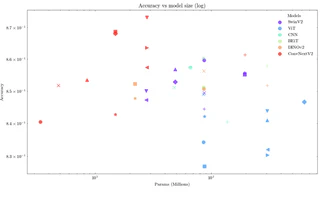
The last decade has seen major advances in artificial intelligence, with breakthrough results in many application areas. A new paradigm shift is currently occurring in AI with the rise of Foundation Models. Our work evaluates the performance of existing visual foundation models, including ViT, CLIP and DINOv2, for astronomical tasks. We adopt a common methodology based on fine-tuning and report results on GalaxyZoo datasets for classification tasks.
Date
Jul 1, 2024 — Jul 5, 2024
Location
Padova, Italy
ePoster presented at the European Astronomical Society Conference 2024 in Padova, Italy, in Session SS10: The impact of the rapidly evolving field of artificial intelligence on astrophysics research: avenues and potential breakthroughs.
This work evaluates the performance of existing visual foundation models (ViT, CLIP, DINOv2) for astronomical data analysis, with a focus on galaxy morphological classification using GalaxyZoo datasets.

Authors
AI for astronomy & astrophysics
PhD student at IRISA, Université Bretagne Sud (expected 2026), and lecturer in computer science,
working on foundation models for astronomy and astrophysics, with a broader interest
in deep learning applied to scientific data.
Also contributing to the UniverseTBD collaboration on vision-language models for astronomy.