NORVIS: a portable broadband imaging spectrograph for auroral observations
Oct 26, 2026·,, ,,,,,,,,,,,,,,,,·
1 min read
Gaël Cessateur
Christian Buil
Guillaume Bertrand
Matthieu Le Lain
Valérie Desnoux
Olivier Garde
Hervé Lamy
Mathieu Barthelemy
Magnar Gullikstad Johnsen
David Bolsée
Urban Brändström
Antoine Calegaro
Fabien Darrouzet
Rowan Dayton-Oxland
Johan De Keyser
Maxime Grandin
Kirsti Kauristie
Romain Maggiolo
Sota Nanjo
Noora Partamies
Abstract
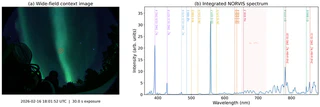
We present NORVIS (NORdlys Versatile Imaging Spectrograph), a portable broadband imaging spectrograph developed for ground-based auroral observations. Based on the Star’Ex optical concept, NORVIS is optimized for auroral emissions and covers approximately 380 to 860 nm in a single acquisition at a moderate spectral resolution of 1.2 nm FWHM. The instrument combines auroral spectroscopy, wide-field context imaging, field operation, automated spectral reduction, and centralized data archiving within a researcher-citizen science framework. First observations were obtained during a campaign at Skibotn Observatory, Norway, in February 2026, during which approximately 1200 spectra were acquired and reduced over three observing nights, with typical exposure times of 30 s. These observations demonstrate the simultaneous detection of key auroral emissions, including the N₂⁺ 1NG bands at 391.4 and 427.8 nm and the [O I] emissions at 557.7 and 630.0/636.4 nm, while also providing access to the Hα region and to O I emissions at 777.4 and 844.6 nm. Representative observations illustrate the potential of NORVIS for emission-ratio diagnostics and geometry-aware interpretation of auroral structures. NORVIS is intended to form the basis of a distributed observing network, with coordinated deployments planned in Kiruna, Skibotn, Svalbard, and northern Finland, followed by permanent installations at Kiruna, Skibotn, the Kjell Henriksen Observatory in Svalbard, and Nyrölä.
Type
Publication
EGUsphere preprint, under review for Geoscientific Instrumentation, Methods and Data Systems
Preprint posted on EGUsphere on October 26, 2026, and under open review for Geoscientific Instrumentation, Methods and Data Systems.
Co-authored paper led by the Royal Belgian Institute for Space Aeronomy together with the STAROS Projects team. It describes the instrument whose observations feed the auroral spectra classification work presented at RFIAP 2026 and in the self-supervised follow-up.

Authors
AI for astronomy & astrophysics
PhD student at IRISA, Université Bretagne Sud (expected 2026), and lecturer in computer science,
working on foundation models for astronomy and astrophysics, with a broader interest
in deep learning applied to scientific data.
Also contributing to the UniverseTBD collaboration on vision-language models for astronomy.