Self-Supervised Representation Learning: From Spectral Foundation Models to Auroral Emission Spectra

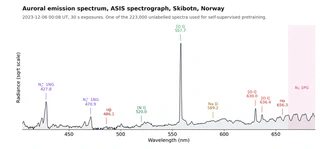 An auroral emission spectrum recorded by the ASIS spectrograph in Skibotn, Norway (December 6, 2023, 00:08 UT), one of the 223,000 unlabelled spectra used for pretraining. Data: BIRA-IASB.
Abstract
Auroral spectrographs such as the Auroral Spectrograph In Skibotn (ASIS) record hundreds of thousands of emission spectra, but only a few hundred can be labelled by an expert. To exploit the rest, we pretrain a 1D Vision Transformer with a masked autoencoder on 223,000 unlabelled spectra. Without labels, its representation recovers the emission-line intensity ratios that physicists use to diagnose the precipitating particles (R² 0.91 vs. 0.77 for an untrained control) and, under one linear probe, classifies as well as 13 features designed by experts. Fine-tuned, the model outperforms the previous supervised auroral classifier on its own benchmark (macro-AP 88.5 vs. 77.8), reaches 0.870 mAP, and exceeds the same architecture trained from scratch by +0.159 with 10% of the labels; attribution shows that it uses both N₂⁺ bands. Could an existing pretrained model replace it? Two astronomical spectral foundation models and a time-series model transfer according to their spectral window: SpectraFM, trained in the infrared, falls below the untrained control, whereas SpecFormer, trained in the optical, approaches in-domain pretraining without reaching it.
Type
Publication
arXiv preprint arXiv:2609.31206, submitted to IEEE ICASSP 2027
Preprint posted on arXiv on September 25, 2026, and submitted to IEEE ICASSP 2027. A joint work with the Royal Belgian Institute for Space Aeronomy, based on the ASIS archive of auroral spectra acquired in Skibotn, Norway.
This work follows the supervised study presented at RFIAP 2026, where a 1D Vision Transformer was trained on 719 expert-annotated spectra. Here, the unlabelled part of the archive (223,000 spectra) is used to pretrain the same architecture with a masked autoencoder, which raises the macro-AP from 77.8 to 88.5 on the same benchmark and shows that the learned representation encodes the emission-line ratios used by physicists, without being told about them.

Authors
AI for astronomy & astrophysics
PhD student at IRISA, Université Bretagne Sud (expected 2026), and lecturer in computer science,
working on foundation models for astronomy and astrophysics, with a broader interest
in deep learning applied to scientific data.
Also contributing to the UniverseTBD collaboration on vision-language models for astronomy.